

To get more collision repair jobs, find the first place good work leaks out of your shop, fix it, and only then pay for more traffic. The leaks sit in five places: demand, visibility, trust, response and booking. You can check all five in an afternoon with your phone, your call log and your last 90 days of ROs.
Start with your own numbers
Before you change anything, write down where you are. Pull the last 90 days and fill in this sheet:
- ROs by source: insurer programs, insurer referrals, repeat and referral, Google, website, dealers, tow, customer-pay.
- Average RO and gross profit per RO.
- New inquiries: calls from new numbers, web forms, texts and messages, counted as people.
- Estimates written, and estimates that became ROs.
- Open capacity: hours your techs could have flagged but didn’t.
Then line up the funnel. Here’s an example with made-up numbers for one month:
| Stage | Example | What it tells you |
|---|---|---|
| New inquiries | 60 | Demand and visibility |
| Reached by a person | 42 | Response |
| Estimate booked | 30 | The first call |
| Estimate done | 26 | Show rate |
| Booked ROs | 18 | The estimate and follow-up |
The biggest drop between two rows is your first fix. In this example, 18 of 60 inquiries never reached a person. That’s the cheapest leak in the shop, because those drivers already called.
Fix the biggest drop first. Everything after it is working with fewer cars.
Leak 1: demand
Demand is how many drivers in your area need the work you want. You can’t create wrecks, but you can check whether you’re fishing in the right pond.
The pond is shrinking in places. CCC’s 2026 Crash Course report found repairable claim volume fell 9.7% across all coverages in 2025, and total losses hit a record 23.1% of all claims. Fewer cars are worth repairing, so the ones that are matter more.
Check demand three ways:
- Your service area. Pull the ZIP codes from your last 100 ROs. That’s where your customers really come from, and it’s usually tighter than the area you advertise.
- Search volume. Google’s free Keyword Planner, inside a Google Ads account, shows rough monthly searches for terms like “collision repair” and “body shop” in your ZIP codes.
- Your mix. If you only chase one kind of job, you only get one kind of demand. Customer-pay work, calibrations, aluminum or a make you’re certified for can widen the pond.
If demand is genuinely thin, the fix is a wider service, a wider area, or referral partners. More ads in an empty market won’t help.
Leak 2: visibility
Visibility is whether the right driver sees your shop at the moment they search. On a phone, that mostly means the map.
Search “collision repair near me” and “body shop near me” on your phone from three places: the shop, a neighborhood where your best customers live, and the edge of your service area. Screenshot each.
Google’s help page on local ranking says local results are mainly based on relevance, distance and prominence. In shop terms:
- Relevance: your Google listing’s category, services and website should say collision repair, not just “auto repair.”
- Distance: fixed. You won’t show on the map far from the shop, which is what ads are for.
- Prominence: reviews and how well known the shop is. Google says “more reviews and positive ratings can help your business’s local ranking.”
If you don’t show in the map near your own shop, fix the listing first: it’s free. If you show near the shop but not where you want cars from, that’s a job for paid search. Our Google Ads vs. local SEO guide explains which to lead with.
Leak 3: trust
A driver who finds you still has to pick you over two other shops. They decide in seconds, on a phone, from your stars, your photos and your first screen.
Reviews carry most of the weight. BrightLocal’s 2026 Local Consumer Review Survey found 47% of consumers won’t use a business with fewer than 20 reviews, 31% will only use a business rated 4.5 stars or higher, and 74% look for reviews written in the last three months.
Check these:
- Review count, rating and the date of your newest review.
- Whether you reply to reviews. BrightLocal found 89% of consumers expect owners to respond.
- Your website’s first screen on a phone: call button, hours, address, a real photo and your rating, before any scrolling.
- Real photos of your building, bays and finished cars. Stock photos tell a driver you have nothing of your own to show.
- An insurance page that answers the questions drivers ask your front desk every day.
The fix for reviews is a habit, not a campaign: ask every customer at delivery, text the link the same day, and reply to every review. Google’s rules ban incentives and ban asking only the happy customers, so ask everyone the same way. Why body shop websites lose customers has a 10-minute test for the site.
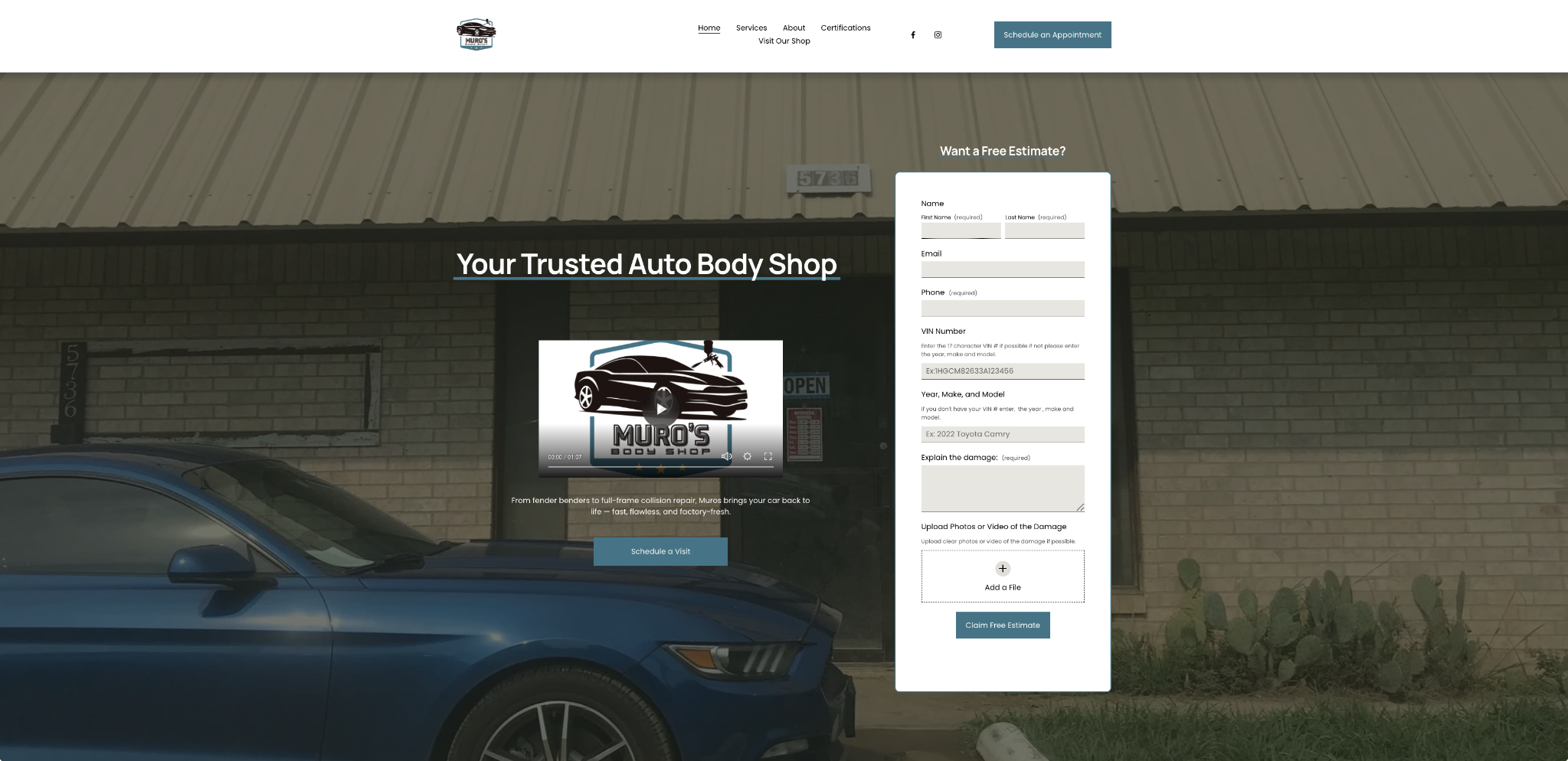
Muro’s Auto Body in Burleson, Texas shows what a site built for trust can do. Mary reports 12 booked jobs in the first 45 days after her new website and lead generation launched, and the site still brings in 2 to 4 jobs a month. The Muro’s case study has the story.
Leak 4: response
This is where most shops lose the most jobs for the least reason. The driver called, and nobody answered, or the callback came after they’d booked somewhere else.
The research on speed is old but clear. Harvard Business Review’s 2011 audit of 2,241 US companies found firms that tried to contact a lead within an hour were nearly 7 times as likely to qualify it as firms that waited even an hour longer, and more than 60 times as likely as firms that waited a day or more. An older MIT and InsideSales.com study found the odds of reaching a lead dropped 100 times between 5 and 30 minutes.
Drivers still want a person. Invoca’s 2025 B2C Buyer Experience Report found 44% of consumers making high-stakes purchases, automotive included, now prefer calling a business for help.
Run this check in one afternoon:
- Export last week’s call log. Count missed calls from new numbers and when they happened.
- Find the callback for each one, and how long it took.
- Send your own web form at 8 p.m. and see when a person replies.
- Call your shop at 12:20 on a weekday and listen to what happens.
Most fixes cost almost nothing: a named owner for every inquiry, a backup phone for lunch, missed calls rolling over instead of going to voicemail, and forms sent to a person’s phone. The real cost of a slow lead response puts a dollar figure on it.
Leak 5: booking
Reaching the driver isn’t the same as booking the car. The call has to end with an estimate time, the estimate has to feel like the right shop, and the follow-up has to happen.
Score ten recent calls against four questions: did we get the name and number in the first minute, did we learn if the car is drivable, did we ask where the claim stands, and did the call end with a specific time? Every “no” on the last question is a lead you paid for and handed back. The front desk phone script gives your team the words.
Then the estimate visit:
- Block estimate slots, so drivers don’t wait 30 minutes in the lobby.
- Walk the car with them and explain the process: estimate, approval, parts, drop-off, teardown and supplements.
- Answer insurance questions you can answer, and promise to call the adjuster for the rest.
- Follow up the same day with a text and two drop-off options, then call on day two.
Price questions are often a driver deciding whether to file a claim. A LendingTree survey of 2,000 US consumers in June 2024 found 39% of insured drivers who had an accident or incident paid for repairs without filing a claim. A written estimate, not a phone guess, keeps those jobs. Why collision leads aren’t turning into booked jobs has a full scorecard.
Keep the bays balanced
More jobs only help if you can fix them on time. J.D. Power’s 2025 U.S. Auto Claims Satisfaction Study put average cycle time for repairable vehicles at 19.3 days. Overfill the shop and yours goes up, and the reviews go down with it.
Check open capacity before you chase volume: flagged hours against what your techs could flag, plus the booth, the frame rack, calibrations and lot space. The tightest one sets your real limit.
Then choose the work. A bigger RO isn’t automatically a better one if it holds a bay for three weeks waiting on parts. Judge jobs by gross profit per bay-day, not ticket size. How to attract more high-value collision work walks through the math.
What fixing one leak is worth
Go back to the example funnel: 60 inquiries, 42 reached, 18 booked. Say you fix response so 54 of the 60 get reached, and everything after that converts at the same rates as before.
| Example | Before | After fixing response |
|---|---|---|
| New inquiries | 60 | 60 |
| Reached by a person | 42 | 54 |
| Booked ROs | 18 | About 23 |
| Repair revenue at a $4,500 example RO | $81,000 | About $103,500 |
About five more cars a month, from the same calls you already get, without a dollar of extra ad spend. That’s why we fix leaks before we buy traffic.
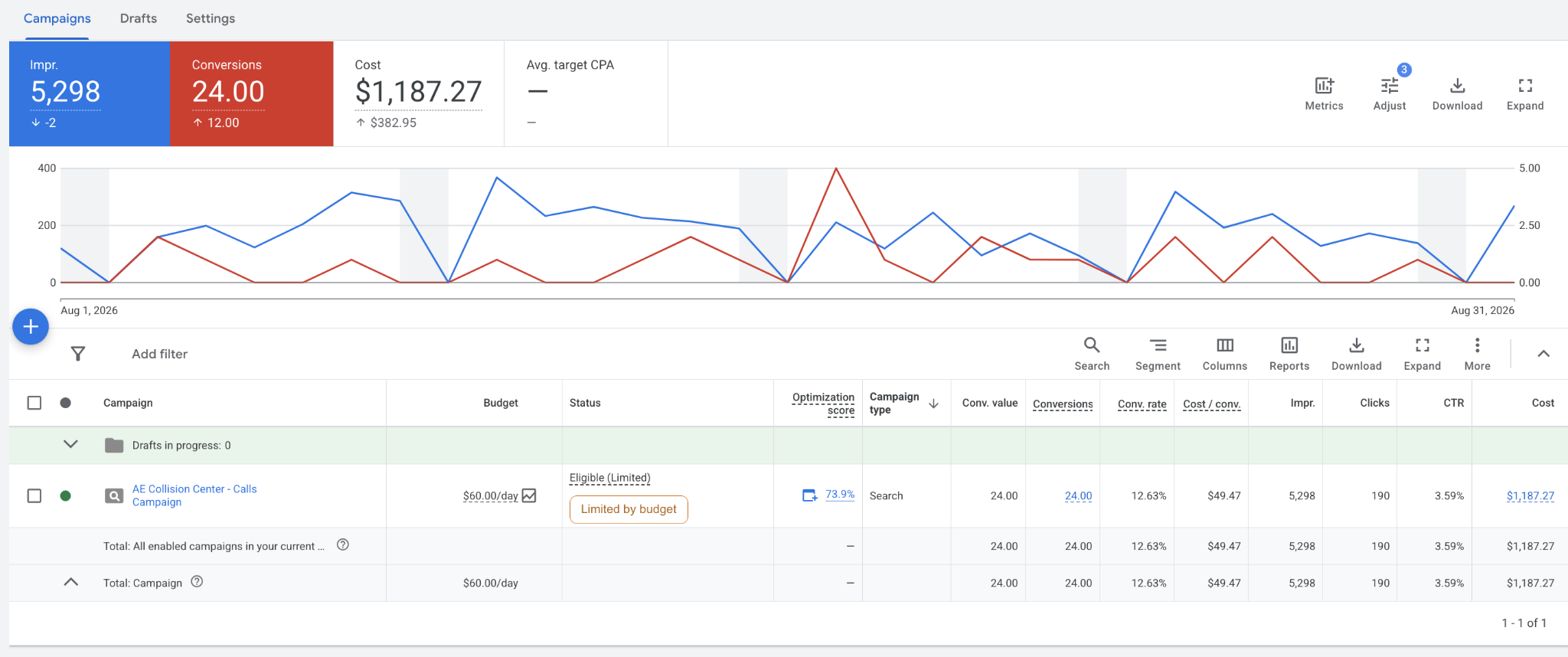
AE Collision Center in Tampa is a real example of fixing the chain in order. The shop was paying for ads without reliable call and form tracking, and the account attracted searches that didn’t fit the repairs it wanted. We rebuilt the campaign around local collision repair searches, corrected the tracking and built a website with real reviews and before-and-after repairs.
In August 2026, month one, the shop reports 9 closed jobs and about $40,000 in repair revenue from $1,187.27 in ad spend. In September, month two, it reports 15 new cars, $117K in repair revenue from Collision Catalyst jobs alone, and $54K take-home. Joniel’s team answered the calls and closed the jobs. The AE Collision Center case study has the evidence.
Your 30-day leak hunt
- Week 1: fill in the numbers sheet and the funnel table from your last 90 days. Circle the biggest drop.
- Week 2: run the visibility and trust checks. Screenshot the map from three spots, count your recent reviews, and test your site on a phone.
- Week 3: run the response check. Pull the call log, time your callbacks and score ten calls with your front desk.
- Week 4: fix the biggest leak only, then measure the next 30 days against the last 30.
If you’d rather have someone do the first pass, that’s what our free 20-minute shop review is for. You leave with the three fixes worth doing first, yours to keep even if we never work together.
Questions owners ask
What’s the fastest way to get more collision jobs?
Fix response first. Calls and forms you already get but don’t answer fast are the cheapest jobs available, because you’ve already paid to win the inquiry. After that, tight search ads during staffed hours bring the fastest new calls.
Should I get on more DRPs to get more work?
Programs can fill bays, but they come with someone else’s terms and volume decisions you don’t control. Most independent shops do better building the work they control alongside any programs they keep. Our guide to growing without leaning on DRPs lays out how.
How do I know which leak is costing me the most?
Line up your funnel from one month: inquiries, reached, estimates booked, estimates done, booked ROs. The biggest drop between two rows is the most expensive leak, and the first one to fix.
Sources
- CCC: Crash Course 2026 report press release (2026)
- Collision Repair Magazine: CCC repair trends, fewer claims and rising complexity reshape shop workloads (2026)
- Google: Tips to improve your local ranking on Google (2026)
- BrightLocal: Local Consumer Review Survey (2026)
- Google: Maps user-contributed content policy (2026)
- Harvard Business Review: The Short Life of Online Sales Leads (2011)
- Invoca: B2C Buyer Experience Report (2025)
- LendingTree: Insurance repairs survey (2024)
- J.D. Power: 2025 U.S. Auto Claims Satisfaction Study (2025)